
The Skeletal System serves many important functions; it provides the
shape and form for our bodies in addition to supporting, protecting,
allowing bodily movement, producing blood for the body, and storing
minerals.
Functions
Its 206 bones form a rigid framework to which the softer tissues and
organs of the body are attached.
- Vital organs are protected by the skeletal system. The brain is
protected by the surrounding skull, and the heart and lungs are
encased by the sternum and rib cage. - Bodily movement is carried out by the interaction of the muscular
and skeletal systems. For this reason, they are often grouped together as the muscular-skeletal system. Muscles are connected to bones by tendons. Bones are connected to each other by ligaments. A joint is where bones meet one another. Muscles which cause movement of a joint are connected to two different bones and contract to pull them together. An example would be the contraction of the biceps and a relaxation of the triceps. This produces a bend at the elbow. The contraction of the triceps and relaxation of the biceps produces the effect of straightening the arm. - Blood cells are produced by the marrow located in some bones. An
average of 2.6 million red blood cells are produced each second by the bone marrow to replace those worn out and destroyed by the liver. - Bones serve as a storage area for minerals such as calcium and
phosphorus. When an excess is present in the blood, buildup will occur within the bones. When the supply of these minerals within the blood is low, it will be withdrawn from the bones to replenish the supply.
Divisions of the Skeleton
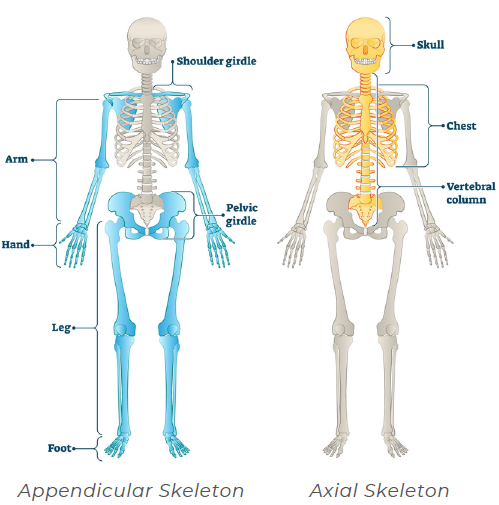
The human skeleton is divided into two distinct parts:
The axial skeleton consists of bones that form the axis of the body and
support and protect the organs of the head, neck, and trunk:
- Skull
- Sternum
- Ribs
- Vertebral Column.
The appendicular skeleton is composed of bones that anchor the
appendages to the axial skeleton:
- Upper Extremities
- Lower Extremities
- Shoulder Girdle
- Pelvic Girdle.
(The sacrum and coccyx are considered part of the vertebral column)
