
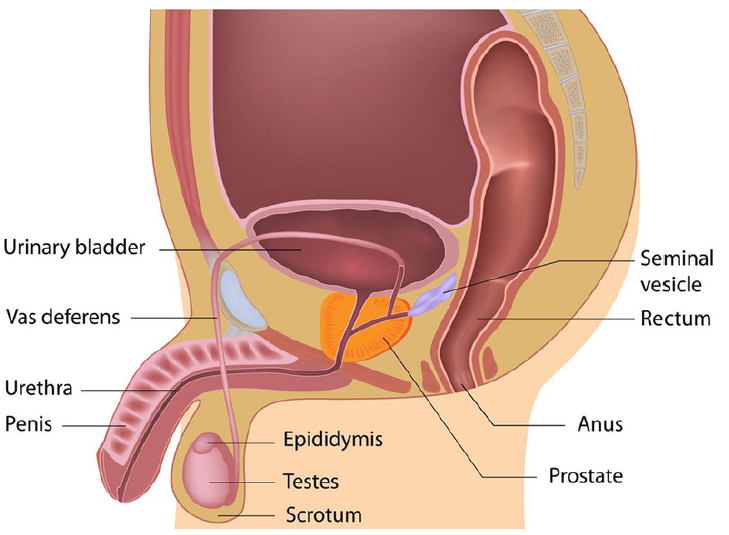
This system consists of organs which allows for the production of a new
individual. The organs involved are the testes, excretory ducts made up
of the epididymis and the vas deferens, glands such as seminal vesicles
and the prostate gland and the penis.
Testes
The testes are the principal structure of the male reproductive system.
They consist of two egg shaped organs, approximately 2 inches in
length. They are suspended from the body by the scrotal sac, which is a
pouch of skin that allows the testes to remain at an optimum
temperature for the development of sperm. The scrotum changes size to
be able to maintain the right temperature. The testicles produce and
store million of sperm cells, and with around 850 feet of tubules being
packed into each testis, this is where sperm are produced by meiosis.
The testes also produce the primary hormone testosterone, which is
involved in puberty. During ejaculation, the muscular movements of the
vas deferens and the ejaculatory duct aid the ejection of the sperm.
Excretory Ducts
The epididymis and the vas deferens make up the duct system of the
male reproductive system. The epididymis is a c shaped set of coiled
tubes that is connected to the vas deferens. They are found at the back
of the testes and are where sperm are matured and stored. The vas
deferens is a muscular tube that passes up along the side of the
testicles and transports the semen.
Glands
The function of the glands in the male reproductive system is to secrete
fluids during ejaculation.
The seminal vessels have a short duct that joins with the ductus
deferens to form an ejaculatory duct that empties into the urethra.The fluid produced assists with the mobility and viability of the
sperm, as well as neutralising the acidity in the female reproductive
tract.
The prostate is a firm, walnut size gland that encircles the urethra as
it leaves the urinary bladder. It secretes a thin, milky coloured liquid
that enhances the mobility of the sperm. It is of an alkaline
substance that counteracts the acidity of the urethra.
The paired bulbourethral glands, or sometimes called the Cowper’s
glands are about the size of a pea and are found near the base of the
penis. During sexual stimulation, theses glands secrete mucus like
fluid which neutralises the acidity of the urine residue in the urethra.
It also provides some lubrication for the tip of the penis during
intercourse.
The Penis
The penis is the sex organ that allows for the passage of both urine and
sperm. Apart from the muscles on the tip of the penis, it does not
contain bone or muscles.
The penis is made up of three columns of erectile tissue that are
wrapped in connective tissue and covered with skin. It has a root, shaft
and glans penis, with the root attached to the pubic arch. The shaft is
the visible part.
The glans penis is formed at the end and the urethra extends
throughout the length of the penis and opens through the external
urethral orifice at the tip of the glans penis. The foreskin, a loose folding
of skin covers the glans penis.
Seminal Fluid
Seminal fluid contains a mixture of sperm cells and secretions from the
accessory glands. In fact around 60% of semen is made up of the
secretions from the seminal vesicles, with the prostate gland providing
the remainder. Only a small amount comes from the bulbourethral
gland and sperm.
In one single ejaculation, the volume of semen can vary from 1.5 to 6.0ml
with usually anything between 50 to 150 million sperm per millilitre of
semen.
