
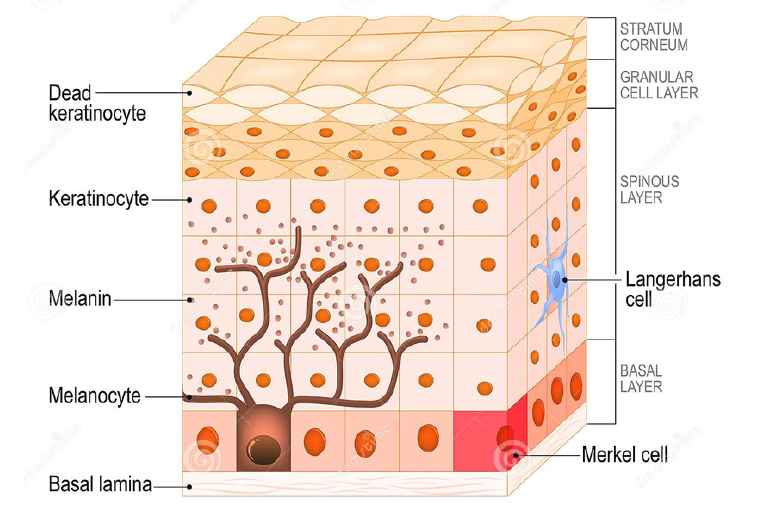
The epidermis protects underlying tissue from infection, dehydration,
chemicals and mechanical stress. The epidermis is made up of 5 layers of
cells, these are structured like a brick wall.
The 5 layers of the epidermis are known as:
- Stratum Germinativum (Germinating Layer) – This is a single layer of soft cuboid cells. These cells divide to form new cells which push the adjacent ones nearer the surface. The cells also divide to repair surface damage to the skin. Smaller cells called melonocytes are also present in this layer, they produce granules or melanosomes. These contain the yellow, brown or black pigment melanin which is the main pigment agent in skins.
- Stratum Spinosum (Prickle Cell Layer) – This layer contains living cells with spiny outgrowths which form bridges between the cells. This layer receives the pigmentation caused by melanin production from the melanocytes situated within the germinating layer.
- The Stratum Germinativum and the Stratum Spinosum together form the living layer of the epidermis known as the Malpighian layer.
- Stratum Granulosum (Granular Layer) – This is an area where a lot of change takes place in the cells. The nuclei of the cells break down leading to the death of the cells. Keratin is produced in this layer and the cells become harder and flatter.
- Stratum Lucidium (Clear Layer) – This is a very shallow layer in facial skin but is thicker on the soles of feet and palms of the hands. The Stratum Lucidium will increase in these areas to form protection against friction. The flattened cells in this layer are completely filled with keratin and are translucent in appearance.
- Stratum Corneum (Horny Layer) – This is the outer layer of the epidermis and consists of flat dead cells of keratin. The cells are
constantly being shed (desquamated) from the surface of the skin.
New cells are constantly being formed in the bottom most layer and they
push the older cells towards the surface. As the cells get pushed upwards,
they become flat, hard and eventually die (keratinisation), forming a
dead layer at the surface.
The cells on the surface of the epidermis are like overlapping tiles and
are constantly being shed. These cells contain the protein Keratin, the
same substance that the scales of reptiles and feathers of birds are
made of. Keratin makes the skin waterproof and tough and adds to its
protective function. The epidermis contains a dark pigment called
melanin. Ethnic skins contain higher levels of melanin than Caucasian
skins. Oriental skins have an additional pigment called carotene which
gives their skin a yellowish tone. Although Caucasian skins do not have
such high levels of melanin, the amount is increased by the action of
ultra-violet light on the skin which stimulates pigment producing cells
called melanocytes to produce more protective pigment.
