
The Heart
The heart is a muscular organ that is primarily a shell containing 4 chambers, which are the right and left atrium and the right and left ventricle. Its main function is to act as a pump and maintain a constant circulation of blood around the body.
The Right Atrium
This chamber receives de-oxygenated blood from the body through the
superior vena cava (head and upper body) and inferior vena cava (legs
and lower torso). An impulse is sent via the sinoatrial node, which causes
the cardiac muscle tissue of the atrium to contract, allowing the tricuspid valve, which separates the right atrium from the right ventricle to open. This allows the de-oxygenated blood which has collected in the right atrium to flow into the right ventricle.
The Right Ventricle
This chamber receives de-oxygenated blood from the atrium as it contracts. The pulmonary valve leading into the pulmonary artery is
closed which allows the ventricle to fill with blood, then to contract. As
this contraction occurs, the tricuspid valve closes and the pulmonary
valve opens. The closure of the tricuspid valve prevents blood from backing into the right atrium and the opening of the pulmonary valve allows the blood to flow into the pulmonary artery toward the lungs.
The Left Atrium
This chamber receives the newly oxygenated blood from the lungs
through the pulmonary vein. A contraction triggered by the sinoatrial
node progresses through the atrium and the blood passes through the
mitral valve into the left ventricle.
The Left Ventricle
This chamber receives the oxygenated blood as the left atrium
contracts, and the blood passes through the mitral valve into the left
ventricle. The ventricle is able to fill with blood as the aortic valve
leading into the aorta is closed. Once the ventricle is full it contracts, the
mitral valve closes and the aortic valve opens. The closure of the mitral
valve prevents blood from backing into the left atrium and the opening
of the aortic valve allows the blood to flow into the aorta and flow throughout the body.
The right side of the heart is completely separate from the left side by
the septum to prevent blood flowing into the opposite side.
The function of the heart is to pump blood around the body and is
approximately the size of a fist. The heart walls are made up of a special
type of muscle called cardiac muscle which allows it to contract and
relax. The heart is centrally located but is tilted so that most of the heart
muscle is to the left. The left ventricle contracts most forcefully, so you
can feel your heart beating stronger on the left side of your chest.
Deoxygenated blood enters the right side of the heart via the inferior
and superior vena cava into the right atrium.
From here it travels through the tricuspid valve, which shuts off once the
blood fills the right ventricle.
The blood then passes through the pulmonary valve into the pulmonary
artery to the lungs to allow the carbon dioxide to be removed and to
collect oxygen.
Oxygenated blood then enters the left side of the heart via the
pulmonary vein and enters the left atrium.
It passes through the mitral valve that closes once the left ventricle is
full. The ventricle now contracts and forces the blood through the aortic
valve into the aorta so that blood is pumped to the head and rest of the
body.
The function of the valves is to prevent the blood from flowing back the
wrong way. The bodies’ blood is circulated through the heart more than
1,000 times per day, and beats an average of 70 to 80 times per minute.
Many factors can affect the pulse, such as exercise, age, gender,
emotion and drugs.
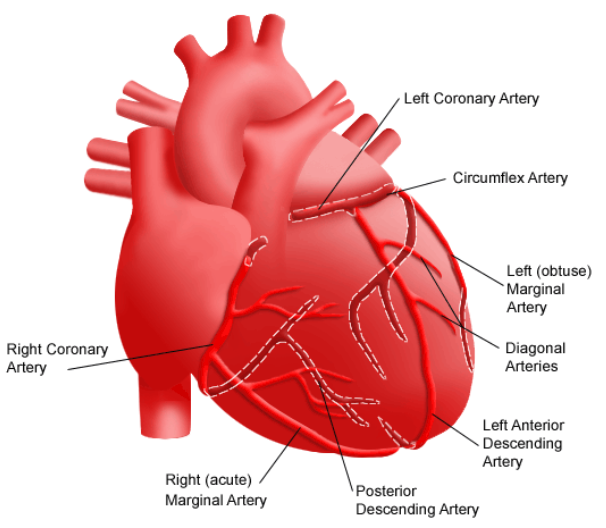
Coronary Arteries
The heart tissue must have a constant supply of oxygen to allow the
heart to contract and relax, so there is a network of vessels that deliver
oxygenated blood to the tissues.
The aorta is supplied with the left and right coronary arteries, which
gradually branch off into smaller vessels. The larger vessels are situated
on the surface of the heart, with the smaller vessels penetrating the
heart muscle. Over time, and in a diet that is rich in cholesterol, plaques
can build up and eventually block the flow of blood through the
coronary artery. When this happens, the heart tissue becomes starved of
oxygen and stops functioning as it should. This results in a heart attack.
Blood Pressure
Blood pressure is the force applied against the walls of the arteries as
the heart pumps blood through the body. The pressure is determined by
the force and amount of blood pumped and the size and flexibility of the
arteries.
Each time the heart beats (about 60–70 times a minute at rest); it
pumps out blood into the arteries.
Your blood pressure is at its highest when the heart beats, pumping the
blood. This is called systolic pressure.
When the heart is at rest, between beats, your blood pressure falls. This
is the diastolic pressure.
Heart failure can occur if the blood pressure is too high, and the heart
becomes enlarged. Aneurysms, which are small bulges may form in
blood vessels, with the commonest locations being in the aorta, arteries
in the brain, legs, and intestines; and the artery which leads to the
spleen.
Kidney failure may occur if blood vessels in the kidney narrow, and
arteries throughout the body will harden, especially those in the heart,
brain, kidneys, and legs. All of this can cause a sudden heart attack,
kidney failure or a stroke. Blood vessels in the eyes can burst or bleed
which may cause vision changes and can result in blindness
In the majority of high blood pressure cases, the cause is unknown. In
fact, you can have high blood pressure for years without knowing it.
When the cause is unknown, you have what’s called essential or primary
hypertension. Factors that may lead to high blood pressure are known
as secondary hypertension, include: Kidney abnormality, a structural
abnormality of the aorta (large blood vessel leaving the heart) existing
since birth, narrowing of certain arteries.
