
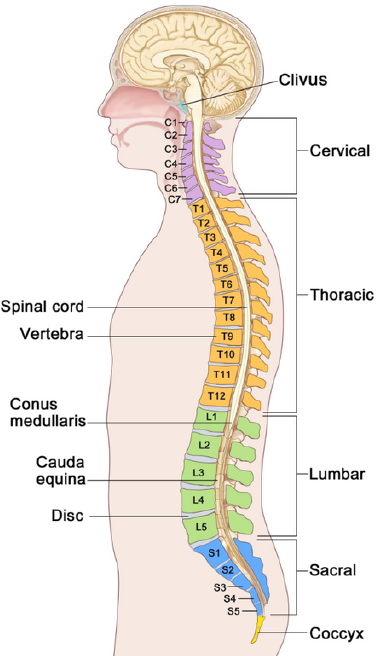
The spinal cord is a long nerve tract that runs from the base of the brain, down through the vertebral column. It consists of millions of nerve fibres which will allow messages to be transmitted.
The spinal cord allows the brain to communicate to all areas of the body. It does this using 31 pairs of spinal nerves which branch off from the spinal cord and are part of the PNS.
Neurons
The spinal cord is a thick bundle containing millions of nerve cells called neurons. A neuron is a cell which is very long and is specialised to be able to transmit nerve impulses. Most of this length is made up of the part of the cell called an axon – this is a nerve fibre thinner than a hair. A neuron is triggered to fire a nerve impulse, which travels along the axon, which then passes from one neuron to another by means of transmitter chemicals.
Long axons enable nerve impulses to be transmitted very quickly. Most nerve fibres are encased in a fatty layer called the myelin sheath. This acts like insulation and gives the nerve its white appearance. Unlike an electrical wire, the axon of a neuron can only transmit impulses in one direction.
