
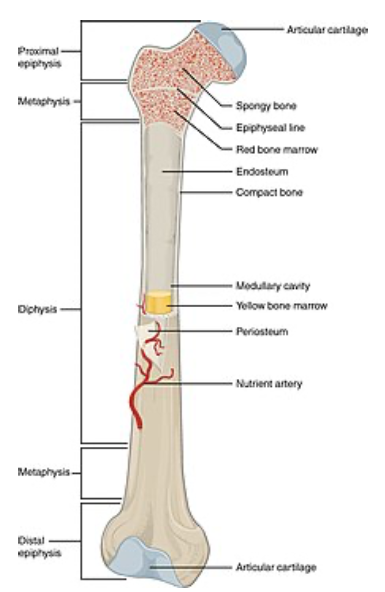
Types of Bone
The bones of the body fall into four general categories: long bones, short
bones, flat bones, and irregular bones.
- Long bones are longer than they are wide and work as levers. The
bones of the upper and lower extremities (e.g. humerus, tibia, femur,
ulna, metacarpals, etc.) are of this type. - Short bones are short, cube-shaped, and found in the wrists and
ankles. Flat bones have broad surfaces for protection of organs and
attachment of muscles (e.g. ribs, cranial bones, bones of shoulder
girdle). - Irregular bones are all others that do not fall into the previous
categories. They have varied shapes, sizes, and surface features and
include the bones of the vertebrae and a few in the skull.
Bone Composition
Bones are composed of tissue
that may take one of two forms.
- Compact or dense bone, spongy or cancellous bone. Most bones contain both types.
- Compact bone is dense, hard, and forms the protective exterior portion of all bones.
Spongy bone is inside the compact bone and is very porous (full of tiny holes). Spongy bone occurs in most bones.
The charts on the following pages show the main bones that you will need to have good knowledge of.
