
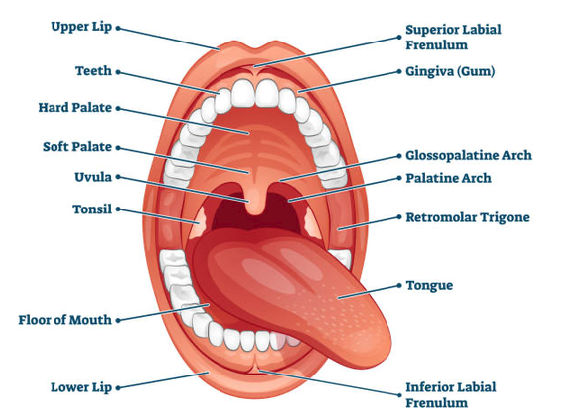
When we think of food or before it even enters the mouth, saliva is
released from the salivary glands which are passed around the mouth
by the tongue. The saliva, which is secreted at around 1 – litres a day,
contains an enzyme called amylase that assists with chemically
breaking down some carbohydrates. The saliva also moistens the food,
making it easier to swallow. Our teeth break down food into smaller
manageable pieces by tearing and shredding.
Movements by the tongue and the jaw push the food to the back of the
pharynx (throat), where a tiny flap of skin called the epiglottis closes
over the entrance of the trachea to prevent choking. This swallowed
food, now called a bolus, is pushed down into the oesophagus, where
wave like contractions, called peristalsis push the food further down to
the stomach. The food passes through a muscular ring, called the
cardiac sphincter into the stomach, which then quickly shuts to prevent
food travelling back up the oesophagus.
