
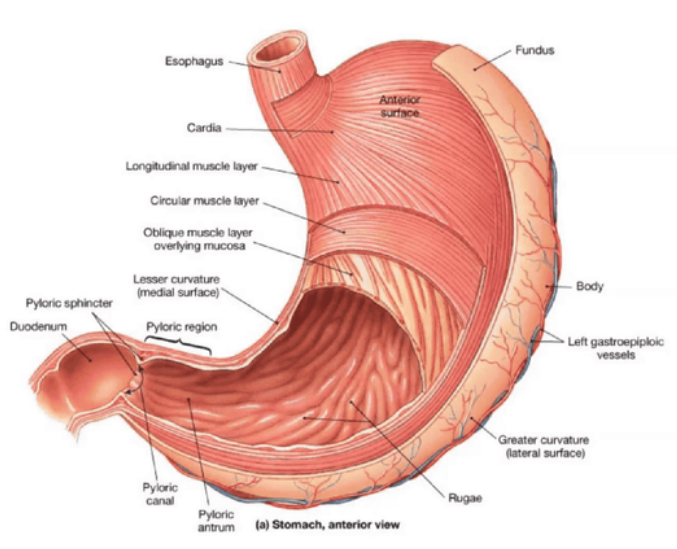
Once in the muscular J shaped sac, the food and liquids are stored and
mixed with strong digestive juices that are secreted by the lining of the
stomach. The bolus is churned and squeezed by the powerful muscular
contractions of the stomach wall. Hydrochloric acid breaks down the
bolus into chyme, which is a liquid. The acid does not damage the
stomach walls due to a thick layer of protective mucus, but if this mucus
becomes limited, then an ulcer may form. With the exception of water,
alcohol and certain drugs, very little of the chyme is absorbed into the
blood from the stomach.
The stomach walls contain three layers of smooth muscle arranged in
longitudinal, circular, and diagonal rows, which allows the stomach to
squeeze and churn the food during mechanical digestion. Whilst this
digestive process in the stomach is occurring, which can take several
hours, a stomach enzyme called pepsin is breaking down proteins. The
chyme is then transported a little at a time through the pylorus into the
small intestine, via the pyloric sphincter.
