
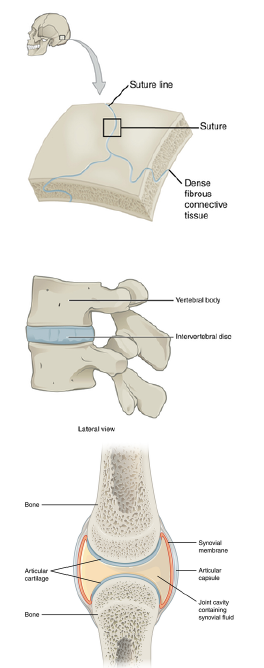
- Fibrous
Fibrous joints connect bones without allowing any movement. The bones of your skull and pelvis are held together by fibrous joints. The union of the spinous processes and vertebrae are fibrous joints. - Cartilaginous
Cartilaginous joints are joints in which the bones are attached by cartilage. These joints allow for only a little movement, such as in the spine or ribs. - Synovial
Synovial joints allow for much more movement than cartilaginous joints. Cavities between bones in synovial joints are filled with synovial fluid. This fluid helps lubricate and protect the bones.
Growth and Repair of Bones
Bone is continually going through a system of growth and repair called
ossification. There are two stages of ossification, with the first stage
consisting of the cartilage being covered with a layer of osteoblasts,
which are cells that are constantly forming new bone, using calcium
and other minerals. Further cells called osteoclasts then break down the
calcium to prevent the bones becoming too dense whilst the bones get
larger. There are also old bone cells called osteocytes which are mature
cells that store the calcium of the body.
