
The digestive system allows for the breaking down of chemicals in the
body that can be absorbed and contains a number of hollow organs
which runs from the mouth to the anus. There are a number of stages to
digestion as it follows its route through the digestive tract, which takes
from 20 – 30 hours, and we are going to look at them in turn as we
follow that journey. The digestive systems main aim is to allow for
mastication, digestion, absorption and then elimination of food.
The Mouth
When we think of food or before it even enters the mouth, saliva is
released from the salivary glands which are passed around the mouth
by the tongue. The saliva, which is secreted at around 1 – litres a day,
contains an enzyme called amylase that assists with chemically
breaking down some carbohydrates. The saliva also moistens the food,
making it easier to swallow. Our teeth break down food into smaller
manageable pieces by tearing and shredding.
Movements by the tongue and the jaw push the food to the back of the
pharynx (throat), where a tiny flap of skin called the epiglottis closes
over the entrance of the trachea to prevent choking. This swallowed
food, now called a bolus, is pushed down into the oesophagus, where
wave like contractions, called peristalsis push the food further down to
the stomach. The food passes through a muscular ring, called the
cardiac sphincter into the stomach, which then quickly shuts to prevent
food travelling back up the oesophagus.
The Stomach
Once in the muscular J shaped sac, the food and liquids are stored and
mixed with strong digestive juices that are secreted by the lining of the
stomach. The bolus is churned and squeezed by the powerful muscular
contractions of the stomach wall. Hydrochloric acid breaks down the
bolus into chyme, which is a liquid. The acid does not damage the
stomach walls due to a thick layer of protective mucus, but if this mucus
becomes limited, then an ulcer may form. With the exception of water,
alcohol and certain drugs, very little of the chyme is absorbed into the
blood from the stomach.
The stomach walls contain three layers of smooth muscle arranged in
longitudinal, circular, and diagonal rows, which allows the stomach to
squeeze and churn the food during mechanical digestion. Whilst this
digestive process in the stomach is occurring, which can take several
hours, a stomach enzyme called pepsin is breaking down proteins. The
chyme is then transported a little at a time through the pylorus into the
small intestine, via the pyloric sphincter.
The Small Intestine
Sometimes called the small bowel, the small intestine is the longest
portion of the digestive tract and is approximately 20 feet long is made
up of the duodenum, the jejunum and the ileum and is a narrow tubed
structure that fills most of the lower abdomen. Once the chyme is in the
duodenum, bile from the gallbladder and enzymes from the pancreas
all combine to complete the final stages of digestion. The acid from the
stomach is neutralised in the duodenums alkaline environment.
Gland cells in the small intestine secrete digestive enzymes that
chemically break down complex food molecules into simpler ones.
The chyme leaves the duodenum and it enters the jejunum and ileum.
Here the nutrients are absorbed through the lining of the small intestine
and transferred to the bloodstream and liver by tiny villi which cover the
walls of the small intestine.
These finger like projections allow for a greater surface area, allowing
the chyme to be absorbed. Such products as fibre and water, that have
not been digested in the small intestine travel to the large intestine. The
ileum is the final portion of the small intestine, which leads into the
large intestine.
The Large Intestine
Sometimes called the large bowel, the large intestine collects and stores
all waste products before processing them into faeces to be removed
from the body. This part of the intestines is around 5 feet long and is
made up of the caecum, appendix, colon and rectum.
The caecum is shaped like a pouch and is found in the right lower
abdomen and stores all the material; fibre, water salts and some
vitamins from the small intestines before moving it along to the colon.
The material enters the expanded caecum through a valve that
separates the small intestines from the large intestine. A small
projection, the appendix, emerges from the caecum, and although it has
no known function it can become troublesome if it becomes infected
Starting at the caecum, the ascending colon travels up the abdomen
towards the liver. The colon then becomes transverse as it travels across
the abdomen, and then descends down the left side of the abdomen to
the sigmoid colon. This S shaped organ is the largest part of the
intestine and joins onto the rectum. All the time that the processed
mixture is in the colon, mucus and bacteria from within the large
intestine mix and starts to form faeces. This water and some vitamins
and minerals from the faeces are then absorbed into the colon.
The faeces are pushed along to the sigmoid colon and finally the rectum
by muscular action, where they are stored until being passed as a bowel
motion.
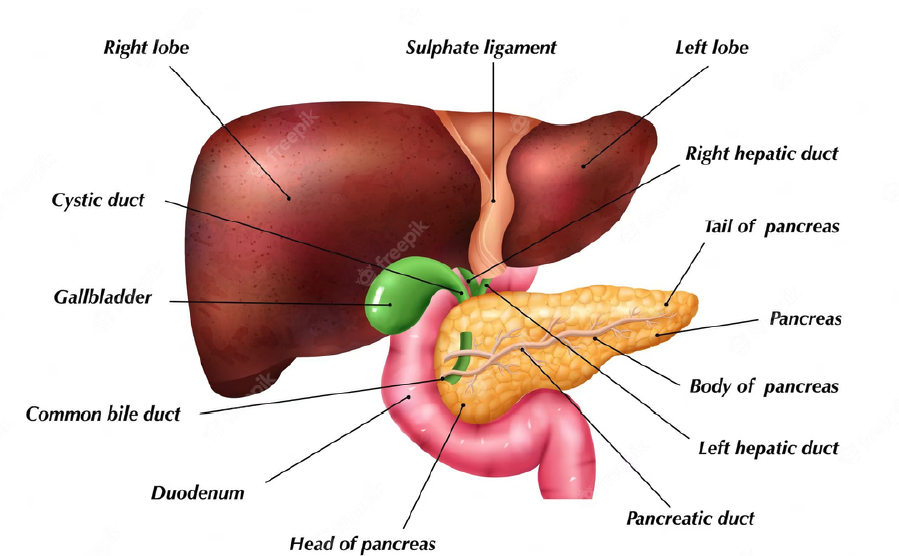
The Pancreas
This 12-15cm organ is located just below the stomach, and slightly
behind it. Around 99% of the pancreas is made up of small clusters of
glandular epithelial cells called acini, which is responsible for producing
the clear pancreatic juice which has many functions. These enzymes
enter the duodenum via two pancreatic ducts, which classifies it as an
exocrine gland. Pancreatic amylase is secreted for digesting
carbohydrates, trypsin to digest proteins and lipase to digest fats. The
remaining 1% of the pancreas contains cells which are arranged into
clusters called Islets of Langerhans. These cells directly secrete the
hormones Insulin and glucagon, needed to control the blood sugar level
into the bloody which also means the pancreas is an endocrine gland.
The Liver
Found in the upper abdominal cavity towards the right and above the
diaphragm, the liver is the heaviest gland in the body. The livers cells or
hepatocytes process chemical changes and its main function is to
regulate the composition of blood, so is therefore highly vascular,
receiving oxygenated blood via the hepatic artery and deoxygenated
blood from the stomach and intestines via the hepatic portal vein. Here,
excess glucose from the blood is removed and stored in the form of
glycogen, until all the glucose in the body has been used up and blood
sugar levels fall. The liver then re-converts the glycogen back into
glucose. Filtering the blood of any harmful substances is crucial and this
is done by the liver extracting it from the blood. Blood is transported
back to the heart via the inferior vena cava.
As well as the mentioned functions, the liver also secretes bile, which
consists of cholesterol, pigments, salts and traces of other substances.
Bile is removed from the liver to the gall bladder for storage via the
canaliculi.
The Gall Bladder
Acting as a storage vessel for bile produced in the liver, this small 4 inch
sac is located behind the liver and has an important function of adding
mucus to the bile which increases its concentration. As the body
requires bile to emulsifier fats, the gall bladder contracts and releases
bile into the bile duct. Along with the pancreatic duct, bile enters the
duodenum.
Enzymes
Enzymes are biological catalysts, made up of proteins, which speed up
chemical reactions in all living things. They are needed to digest food
and only work for one specific reaction. Human saliva contains an
enzyme called amylase which breaks down starch into a sugar called
maltose. The pancreas is the main digestive gland in the body
In the stomach the gastric enzymes pepsin, gelatinase, gastric amylase
and gastric lipase are secreted. All of these enzymes have a different
role, from breaking down proteins to degrading starch.
Digestive Hormones
As well as releasing enzymes, at least four digestive hormones are
released which help aid and regulate the digestive system. These consist
of gastrin found in the stomach, secretin, cholecystokinin and gastric
inhibitory peptide also found in the duodenum.
Absorption and Transportation of Nutrients
The human body is made up of two-thirds water and it is an essential
nutrient that is involved in every function of the body. Water helps
transport nutrients and waste products in and out of cells and is
necessary for all digestive, absorption, circulatory, and excretory
functions. Maintenance of the proper body temperature is determined
by water and it is recommended that you drink at least eight 8-ounce
glasses of water each day.
Carbohydrates, such as starch and sugars need to be broken down into
simpler molecules by enzymes in the saliva and pancreatic enzymes.
Starches are digested by the enzyme in saliva and pancreatic juices and
sugars are digested by an enzyme found in the lining of the small
intestine.
Fibre is indigestible and does not get broken down at all by enzymes.
Soluble fibre can be dissolved in water, whereas insoluble fibre passes
through the intestines unchanged.
Fats need to be broken down by being dissolved in the intestine and
then by the bile acids produced by the liver, so they form tiny droplets.
These droplets are then carried into the cells of the mucosa before
changing back into large molecules. They then pass into the lymphatic’s
to be carried to the veins of the chest, and by blood vessels to the fat
deposits in the body where they are laid down as storage.
Proteins must start to be digested by an enzyme in the stomach before
they can be used to help build and repair the bodies cells and tissues.
Once in the small intestine, pancreatic enzymes complete the
breakdown of larger protein molecules into smaller ones called amino
acids. Once absorbed, they can be carried to all parts of the body for
growth and repair.
Vitamins are classified by being either water-soluble vitamins (the B
vitamins and vitamin C) or fat-soluble vitamins (vitamins A, D, E, and K).
It is difficult to store water-soluble vitamins, and any excess are flushed
out in the urine. Fat- soluble vitamins can be stored in the liver and the
fatty tissue of the body.
Minerals are needed in small amounts. Minerals are classified into
essential minerals and trace minerals, with the body only needing very
small amounts of trace minerals. Those classified as essential are
magnesium, sulphur, sodium, potassium, phosphorus, iron and calcium.
The main function of minerals is to control body fluids, build strong
bones and teeth and to assist with converting food into energy that can
be used.
Water is an essential nutrient which makes up around 50-75% of our
body weight. It removes toxins in the body, regulates temperature and is
essential for growth of the body.
